
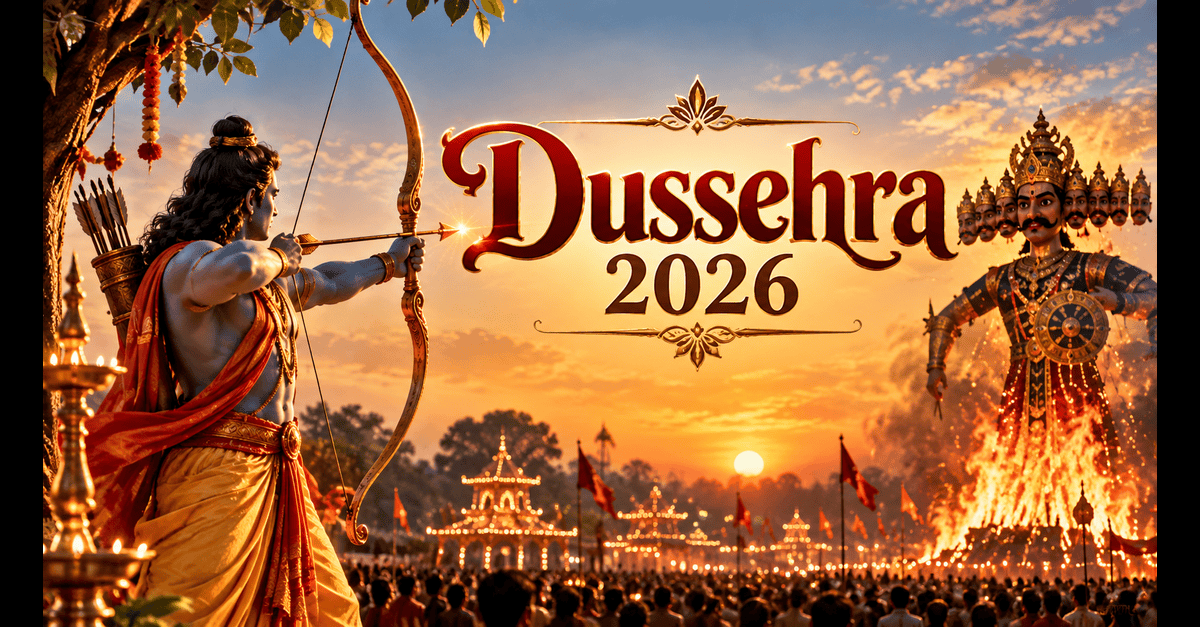
Every year, as autumn settles in and the festive season peaks across India, one festival stands out for its energy, drama, and deep symbolism — Dussehra. Also called Vijayadashami, this festival marks the triumph of good over evil and brings families, communities, and cultures together in celebration. Let’s explore everything about Dussehra 2026, from its date and timing to its rich history and meaning
For complete details on the significance, rituals, and auspicious timings of Sharad Purnima 2026, read our detailed guide on Sharad Purnima 2026.
Let us explore the complete significance and essential details of Dusshera 2026
When is Dussehra 2026?
Dussehra 2026 falls on Tuesday, October 20, 2026. The festival always arrives on the tenth day, or Dashami, of the bright fortnight (Shukla Paksha) in the Hindu month of Ashwin. Since it follows the lunar calendar, the exact date shifts a little each year, but it always lands somewhere in September or October.
Here’s the key timing to keep in mind:
- Dashami Tithi begins: October 20, 2026, at 12:50 PM
- Dashami Tithi ends: October 21, 2026, at 2:11 PM
- Vijay Muhurat (New Delhi): 2:04 PM to 2:51 PM, roughly a 47-minute window
Note-This Vijay Muhurat is considered the most auspicious time for performing rituals. Because timings can vary slightly from city to city, it’s always wise to check your local Panchang before starting any important ceremony.
What Does Dussehra Actually Mean?
The word “Vijayadashami” breaks down neatly: vijaya means victory, and dashami means the tenth day. Put together, it simply means “victory on the tenth day.” That single phrase captures the heart of the festival — a celebration of righteousness winning over wrongdoing, and light overcoming darkness.
Interestingly, Dussehra doesn’t tell just one story. Depending on which part of India you’re in, the festival honours different legends. Yet they all circle back to the same core idea: evil never lasts, and good always finds a way to prevail.
The Story of Lord Rama and Ravana
In North and Central India, Dussehra is closely tied to the Ramayana. According to the epic, Ravana, the powerful king of Lanka, abducted Sita, the wife of Lord Rama. A long and fierce war followed between Rama’s forces and Ravana’s army, and after days of battle, Rama finally defeated Ravana, restoring peace and justice.
This victory is precisely what Dussehra commemorates. To mark the occasion, communities across North India build massive effigies of Ravana, along with his brother Kumbhakarna and son Meghnada. As evening falls, these effigies go up in flames amid cheering crowds, fireworks, and festive music.
The burning isn’t just a spectacle. It symbolically destroys arrogance, greed, and cruelty, reminding everyone that these traits, no matter how powerful they seem, eventually fall.
The Story of Goddess Durga and Mahishasura
Meanwhile, in eastern and northeastern India, the festival tells a different but equally powerful story. The demon Mahishasura had grown so powerful that he threatened both gods and humans, so Goddess Durga fought him in an intense nine-day battle. On the tenth day, she finally defeated him, restoring balance and peace.
Because of this legend, Vijayadashami also marks the conclusion of Durga Puja. On this day, devotees bid farewell to the goddess through Durga Visarjan, immersing her idol in a river or water body with heartfelt devotion — a moment that feels both celebratory and bittersweet as the nine days of festivities come to a close.
Why Do We Celebrate Dussehra?
At its core, Dussehra isn’t just a religious event — it’s a reminder to live better. The festival carries several timeless lessons that stay relevant no matter the era:
- Truth wins, even when lies seem stronger.
- Good can overcome evil, no matter how difficult the situation is.
- We should stay brave when life gets challenging.
- Making the right choices helps us stay on a good path.
- It is important to leave behind bad habits and negative thoughts.
- Every new beginning brings hope, positivity, and fresh opportunities.
Because of these lessons, Dussehra doubles as a moment of self-reflection. Many people use the day to start new ventures, buy something meaningful, or simply reset their intentions for the months ahead.
Why Dussehra Holds Special Significance?
Beyond its religious roots, Dussehra holds strong cultural and social value across India. Since it’s considered an auspicious day, people often choose it to launch new businesses, sign important agreements, or make big purchases. It’s also seen as the perfect time to seek blessings for success, prosperity, and courage in the journey ahead.
Regional customs add even more colour to the celebration. In Maharashtra, for instance, people exchange Apta leaves as a symbol of gold, wishing each other prosperity and good fortune. In Karnataka, the grandeur reaches its peak with Mysuru Dasara — a spectacular ten-day celebration featuring illuminated palaces, cultural performances, and a royal procession that draws visitors from around the world.
How Dussehra Is Celebrated Across India?
Since India is a land of diverse traditions, Dussehra doesn’t look the same everywhere. Here’s how different regions bring the festival to life.
Ravana : Across North Indian cities, massive Ravana effigies rise into the sky before crowds gather to watch them burn. The event is usually paired with fireworks, music, and community festivities that go on late into the evening.
Ramlila : In the days leading up to Dussehra, towns and cities stage Ramlila — a dramatic retelling of Lord Rama’s life through dance, dialogue, and music. These performances keep the story alive for younger generations and turn the festival into a shared community experience.
Durga Visarjan: In West Bengal and several eastern states, Vijayadashami wraps up the grand Durga Puja celebrations. Families perform final rituals before immersing Durga’s idol in water, marking a moving farewell to the goddess.
Mysuru Dasara: Karnataka’s Mysuru Dasara stands out as one of the most iconic Dussehra celebrations in the country. With illuminated palaces, cultural showcases, and a grand procession, it attracts thousands of visitors every year and reflects centuries of royal tradition.
To get complete information about Radha Ashtami 2026, watch the full video in Hindi.
Conclusion:
Dussehra 2026 arrives on October 20, bringing together mythology, devotion, and culture in a way few other festivals can match. Whether you watch a Ravana effigy go up in flames, join a Ramlila performance, bid farewell to Goddess Durga, or witness the splendour of Mysuru Dasara, the message stays consistent: good always finds a way to overcome evil.
More than just a celebration, Dussehra encourages us to release negativity, embrace truth, and step into the future with renewed hope. As you plan your Vijayadashami 2026 celebrations, take a moment to reflect on what the festival truly represents — courage, righteousness, and the promise of new beginnings.
For your Kundali or any astrology-related guidance, you can contact Astro Sarathi.
Astro Sarathi
Mobile No.: 91-9667557994
WhatsApp: +91-9858598765
We take pride in providing our valued clients with the best spiritual solutions and an excellent service experience.
Our services include:
 ऑनलाइन पूजा (Online Puja)
यंत्र एवं कवच (Yantras & Kavach)
कुंडली विश्लेषण (Kundali Vishleshan)
वास्तु शास्त्र परामर्श (Vastu Shastra Consultations)
रत्न (Gemstones)
रुद्राक्ष (Rudraksha)