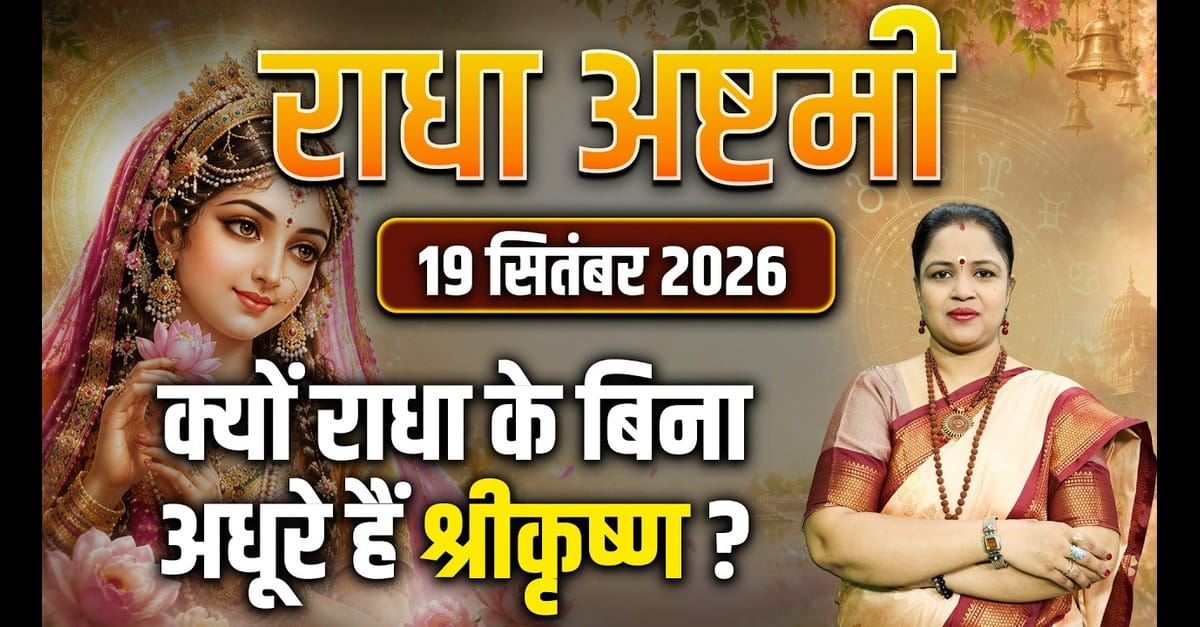
Every year, as Bhadrapada month rolls in, Vrindavan comes alive in a special way. Temples fill with flowers, kirtans echo through the lanes, and devotees get ready for one of the most loved festivals in the Krishna bhakti tradition — Radha Ashtami. This day marks the appearance of Shrimati Radharani, Lord Krishna’s eternal beloved and a symbol of pure, selfless love.
At AstroSarathi, we notice something interesting every year around this time. People don’t just ask about rituals — they ask about love, relationships, and why some bonds feel harder than others. Turns out, Radha Ashtami has answers for that too.
Let us explore the complete significance and essential details of Radha Ashtami 2026
Radha Ashtami 2026: Date and Timing
Radha Ashtami will be celebrated on Saturday, 19 September 2026. It falls on Ashtami Tithi during Shukla Paksha of Bhadrapada month, exactly 15 days after Janmashtami. Many devotees see this as meaningful — Krishna’s appearance is followed, a fortnight later, by the appearance of the one who completes him.
Here are the timings for Ashtami tithi –
- Ashtami Tithi starts: 18 September 2026, 1:00 PM
- Ashtami Tithi ends: 19 September 2026, 3:26 PM
- Madhyahna (midday) puja muhurat:11:01 AM to 1:28 PM
Radharani is believed to have appeared at midday. So, unlike most festivals, the main puja and darshan happen around noon, not at sunrise or sunset. If you’re planning to visit a temple or do a puja at home, it’s best to keep this midday window in mind.
Why Radha Ashtami is So Special?
Radha is not just a figure from mythology. In Krishna bhakti tradition, she represents devotion itself. If Krishna is the one who is loved, Radha is love — pure, complete, and without any conditions. She is often seen as the ideal example of surrender, patience, and pure affection.
That’s why this festival feels different from others. It’s not only about celebration; it’s also about deep longing and devotion. Many devotees travel to Barsana, Radharani’s birthplace, where the celebrations are said to be the biggest and most joyful in the entire region. Flowers are showered everywhere, swings are decorated, and the whole atmosphere feels alive with love and colour. Even people who don’t usually follow religious festivals closely often say there’s something different about the mood in Barsana and Vrindavan on this day.
How People Celebrate Radha Ashtami?
Every temple has its own style of celebration, but some common practices are followed almost everywhere:
- Fasting through the day, often broken after the midday puja, or after sunset for stricter observers
- Abhishek, where the deities are bathed with panchamrit, fruit juices, and fragrant water
- Kirtans and bhajanssung in praise of Radharani and her bond with Krishna
- Flower decorations, usually in pink and gold shades, covering the deities and the temple
- Charity and seva, as giving on this day is considered very auspicious and good for the mind
If you can’t visit Vrindavan or Barsana this year, you can still celebrate at home in a simple way. Do a small puja, chant the Radharani Pranam Mantra, light a diya, and keep a partial fast if that feels right for you. The intention behind the ritual matters more than how grand it is.
What Radha Ashtami Teaches Us About Love and Devotion?
Radha Ashtami is more than a festival associated with the birth of Radha Rani. For devotees, it carries a deeper message about the nature of love and devotion. Radha Rani’s connection with Lord Krishna is traditionally seen as an example of प्रेम that goes beyond expectations, attachment, or personal gain.
The occasion encourages devotees to look at their own relationships and values with greater understanding. Love becomes more meaningful when it is accompanied by respect, patience, trust, and the willingness to care for others without expecting something in return.
Radha Ashtami also highlights the importance of devotion in everyday life. A person does not necessarily need elaborate rituals to express faith. Remembering the divine with sincerity, treating others with kindness, and maintaining a compassionate attitude can also become part of one’s spiritual journey.
For devotees, this is what makes Radha Ashtami especially meaningful: it brings together faith, love, humanity, and devotion, offering a reminder that spirituality can be reflected not only in पूजा but also in the way we treat the people around us.
Radha Ashtami: A Reminder of Selfless Devotion
Radha Ashtami 2026 is not just an occasion to worship Radha Rani but also a time to reflect on love, faith, humility, and selfless devotion. In the Radha-Krishna tradition, Radha Rani is regarded as a symbol of pure love that is free from expectations.
The significance of Radha Ashtami goes beyond rituals. The festival encourages devotees to seek inner peace, strengthen their faith, and bring more kindness and understanding into their relationships. Remembering Radha Rani through prayer, naam smaran, or devotional songs can make the day more meaningful.
Radha Ashtami reminds devotees that true devotion is expressed not only through पूजा but also through our thoughts, actions, and the way we treat others.
To get complete information about Radha Ashtami 2026, watch the full video in Hindi.
Conclusion:
Radha Ashtami teaches us to look at love a little differently — not as something to chase or bargain for, but as something to give freely, without expecting much in return. That’s not always an easy lesson, astrology aside.
If this festival makes you reflect on your own relationships, emotional patterns, or why certain connections in your life feel harder than others, it may be worth understanding what your Venus placement actually says about you.
For your Kundali or any astrology-related guidance, you can contact Astro Sarathi.
Astro Sarathi
Mobile No.: 91-9667557994
WhatsApp: +91-9858598765
We take pride in providing our valued clients with the best spiritual solutions and an excellent service experience.
Our services include:
 ऑनलाइन पूजा (Online Puja)
यंत्र एवं कवच (Yantras & Kavach)
कुंडली विश्लेषण (Kundali Vishleshan)
वास्तु शास्त्र परामर्श (Vastu Shastra Consultations)
रत्न (Gemstones)
रुद्राक्ष (Rudraksha)